

25 Fun Classroom Games That Keep Students Laughing and Learning
Fun classroom games are short, playful activities that get students moving, talking, and learning without worksheets. The best ones need little prep, work in any subject, and include every student, not just the loudest. This guide shares 25 teacher-tested favorites, plus a fair way to pick players so nobody complains.
Every teacher has been there: the lesson finishes ten minutes early, the WiFi dies mid-activity, or the class is too restless for one more worksheet. A good bank of games saves those moments.
What are the best fun classroom games for elementary students?
The best fun classroom games for elementary students are simple, physical, and short: games like Four Corners, Silent Ball, and Around the World adapt to any subject and finish in under ten minutes. They keep every child involved, and full participation is what keeps the room calm instead of chaotic.
Younger students learn through movement, so the strongest games for early grades get bodies moving. For classroom games for kindergarten specifically, keep rules to one or two steps and rounds under five minutes. Who’s Missing (guess which child hid), Freeze Dance, and a scavenger hunt for colors or shapes are perfect for ages four to six. Older elementary students can handle light strategy and team play, which is where review games shine.
High-energy games that burn off wiggles
- Four Corners: Label the four corners of the room 1 to 4. Students pick a corner while you count down with eyes closed, then you call a number and that corner sits out. Last one standing wins.
- Silent Ball: Students toss a soft ball around the room in complete silence. Talk, drop the ball, or throw badly and you sit down.
- Simon Says Remix: Play it straight for little kids, or add subject twists for older ones. “Simon says touch something blue” becomes “Simon says point to a prime number.”
- Freeze Dance Math: Play music, let them dance, and when the music stops call out a math fact. Students show the answer with their fingers. Nobody realizes they are drilling facts.
- Balloon Pop Review: Tape review questions inside blown-up balloons. Pop a balloon, answer the question. Loud, joyful, and perfect the day before a quiz.
Educational games that secretly teach
The best educational games for class feel like play and work like review. These five adapt to any subject, from spelling to science, and two of them rank among the most fun math games to play in the classroom.
- Around the World: Two students stand, you ask a question, and the faster correct answer “travels” to the next desk. Kids beg to play this before math tests.
- Quiz Quiz Trade: Give every student a flashcard. They pair up, quiz each other, trade cards, and find a new partner. In three minutes the whole class has practiced ten facts.
- Pictionary Relay: Split the class into teams. One student draws a vocabulary word while their team guesses, then the marker passes on. Works for science terms, spelling words, and foreign language vocabulary.
- Vocabulary Bingo: Students fill blank bingo cards with this week’s words. Read definitions aloud instead of the words themselves, so they have to think, not just listen.
- Word Chain: One student says a word, the next must say a word starting with the last letter. Add a subject rule (only animals, only verbs) and it becomes real review.
Quiet games for focused moments
Not every game needs noise. These calm options are ideal for the last ten minutes of the day or for settling a buzzing class.
- Would You Rather: “Would you rather have fins or wings?” Kids vote with fingers and defend their choice in one sentence. Speaking skills, zero pressure.
- Twenty Questions: Think of a vocabulary term and let the class ask yes-or-no questions to guess it. Then hand the role to a student.
- Mystery Number: Pick a number between 1 and 100. Students ask yes-or-no questions to narrow it down. Logic and place value in one game.
- Story Chain: Start a story with one sentence; each student adds the next. Set it in the period or book you are studying for writing practice.
How do you pick students fairly for classroom games?
The fairest way to run fun classroom games is to take the choosing out of your hands and give it to chance. A public, visible random pick means no student feels skipped and nobody can accuse you of favoritism, which ends the most common game-day argument before it starts.
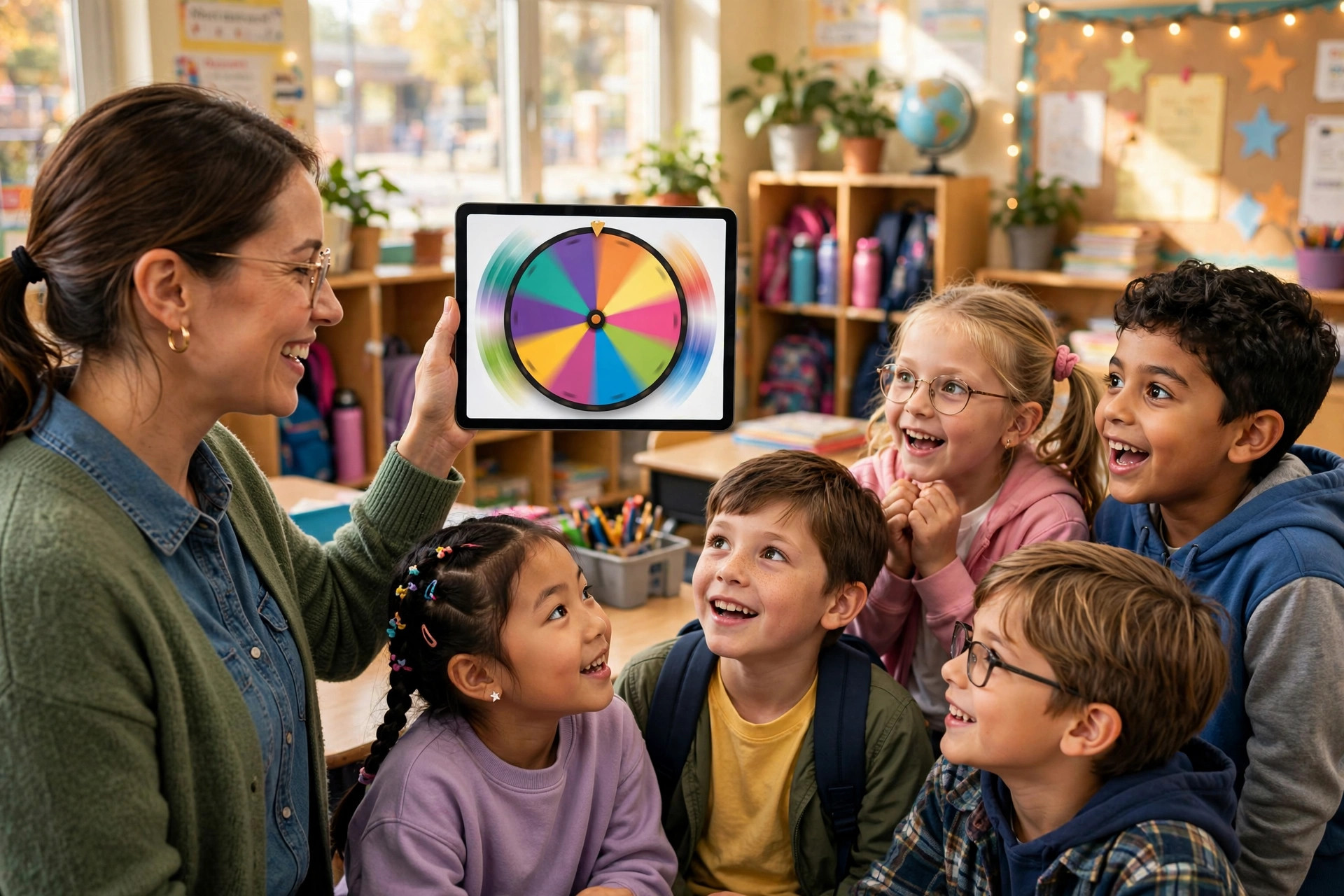
Most teachers start with popsicle sticks in a jar, and those work fine at first. The problem is that students are observant: they notice when the same sticks surface, they suspect the jar is not really shuffled, and the teacher still looks like the one in control. A digital spinner projected on the board changes the psychology completely. Everyone watches the wheel spin and sees the name it lands on, and the result feels final in a way a hand reaching into a jar never does.
A free wheel of names handles the details teachers actually need. Paste your class list once and spin to pick who answers first, who goes next, or who gets the bonus question. Turn on remove-after-pick and every student gets exactly one turn before anyone goes twice, which ends “she already had a turn” complaints fast. It also works beautifully for classroom ice breaker games in the first week of school, when you are still learning names.
Teams are the other fairness headache. Hand-picked teams always look rigged, and counting off by numbers splits up friends in ways that feel arbitrary. For the classroom team building activities and team building games classroom teachers run all year, a random name picker with a team maker mode builds balanced groups in seconds and puts the blame for lopsided teams on luck, not on you. Students accept a loss to chance far more gracefully than a loss to the teacher’s seating chart.
Set turn order the same way. Before a review game or class tournament, spin a classroom name picker wheel to decide who goes first, second, and third. Post the order where everyone can see it, and the “who starts” argument disappears.
What are some quick 5-minute filler games between lessons?
The best quick games to play in the classroom need zero setup and end on a timer, because fillers only work when they do not eat into the next lesson. Match the game to the moment: pick a calm one when the class is buzzing and needs settling, and an energetic one when they are sluggish after lunch. Keep three or four of these in your head and the awkward gaps between activities disappear.
- Minute to Win It Challenges: Stack cups into a pyramid, move a cookie from forehead to mouth without hands, or bounce a ping pong ball into a cup. Sixty seconds, huge cheers. Minute to win it games classroom teachers swear by work because the time limit does the classroom management for you.
- Stand-Up Trivia: Read a statement. True, students stand; false, they stay seated. Wrong answers sit out the next round. A perfect sponge activity for transitions.
- Categories Countdown: Pick a category (fruits, countries, verbs) and go around the room. Each student names one item in three seconds or sits down.
- Two Truths and a Lie, Teacher Edition: Tell two true facts and one lie about yourself. Students vote on the lie. A perfect early-year ice breaker, and one of the easiest ice breakers with students who are still shy.
- Heads Up Seven Up: Seven students put heads down with thumbs up. The seven walk around and each presses one thumb down, then the chosen students guess who picked them. A classic for a reason: it takes four minutes and the whole class plays.
Which classroom games work well on a smartboard?
The games that work best on a smartboard are the ones where the whole class can see and touch the action: spinner wheels, team quizzes, sorting challenges, and voting games.
Classroom online games have a real advantage here because they need no printing, cutting, or laminating. Free classroom interactive games like digital word scrambles, geography tap quizzes, and timed math duels let students come up to the board in turns while the rest of the class plays along from their seats. These are true games to play in class together, not solo screen time. Project a spinner and let it decide which team answers the bonus question or who draws the vocabulary word. And when the class cannot agree on what to do with ten spare minutes, put the options on a wheel and let everyone watch it spin the wheel to decide. The argument ends instantly.
- Digital Draw and Guess: One student draws on the smartboard while the class shouts guesses. Use vocabulary words and it becomes review.
- Tap Quiz Duel: Two students race to tap the correct answer on screen while the audience plays along on mini whiteboards.
- Drag-and-Drop Sort: Sort words into categories (noun or verb, living or nonliving) by dragging them on the board. Teams take turns and the class judges.
- Class Vote: Post a Would You Rather or a review question and let students vote with colored cards. Tally the results together for a quick math moment.
Two setup habits make smartboard games run smoothly. First, fix the turn order before you start, by spinning names or going row by row, so you never lose minutes to volunteers arguing. Second, keep everything touch-friendly: big buttons, one action per turn, nothing that needs typing. The moment students are waiting on tech, you have lost the room.
What are good zero-prep classroom games for substitute teachers?
Substitute teachers need fun classroom games that explain themselves in one sentence and require no materials, because a sub walks in cold with no idea where anything is stored. Leave two or three of these in your sub plans and your class stays productive even when you are out sick.
- Twenty Questions: The sub thinks of a term from the current unit (leave a word list in the plans) and the class guesses.
- Silent Ball: Needs one soft ball or even a scrunched paper ball. It burns energy without noise complaints from the next room.
- Story Chain: Each student adds one sentence. Give the sub a starting line tied to your current topic.
- Categories: Go around the room naming items in a category. Anyone who repeats a word or stalls is out for that round.
- Classroom Charades: Students act out vocabulary words while the class guesses. Leave the word list in your plans and the sub needs nothing else.
A short fairness note for subs helps too: ask them to let chance pick players instead of raised hands. A quick random draw keeps order, and students test substitutes far less when the rules feel neutral from the very first minute.
Experienced teachers keep a “sub tub” by their desk: a soft ball, a timer, printed bingo cards, and a one-page list of these games with the current unit’s word list attached. A substitute who finds that tub teaches a good day. Ten minutes of prep on your side buys a calm classroom in your absence.
How do you keep classroom games calm and under control?
Even the best-planned fun classroom games can get loud, so the trick is setting the rules before the fun starts. Games go wrong when students discover the boundaries by crossing them, so state yours up front.
- Rules first, always: Explain the game, model one round, then ask a student to repeat the rules back. Thirty seconds of clarity saves ten minutes of chaos.
- Use a visible timer: A countdown on the board makes “one more round” arguments impossible. When the timer ends, the game ends.
- Give eliminated players a job: Seated students become judges, scorekeepers, or cheer squads. Nobody likes sitting out with nothing to do.
- End with a reset ritual: Clap patterns or a call-and-response practiced in advance bring the energy down fast.
- Debrief in one sentence: Ask “what did we practice today?” after review games. It reminds students the game had a purpose.
Handle sore losers before they happen. Announce at the start that arguing with a result ends your turn, and praise good sportsmanship out loud when you see it. For highly competitive classes, favor team games over elimination games: losing as a group stings less, and teammates coach each other instead of gloating.
Keep this list where you can grab it fast: on a clipboard by your desk or bookmarked on your phone. With 25 fun classroom games ready to go, you will never lose ten minutes to restlessness again, and your students will remember your class as the one where learning felt like play.
Frequently asked questions
What are fun classroom games for high school students?
High school students enjoy games with strategy and stakes: trivia tournaments, debate-style Would You Rather, and Minute to Win It challenges. An escape room in classroom format works especially well for teens: hide clues around the room that review the unit, set a 30-minute timer, and let teams race to break out. Older students want real problems to solve, not just speed and luck.
How long should a classroom game last?
Most classroom games work best at 5 to 15 minutes. Brain breaks and fillers should stay under 5 minutes, review games can run 10 to 15, and anything longer needs clear phases or teams or attention fades. Set a timer before you start: it keeps the pace snappy and gives you a neutral reason to stop when time is up.
What are easy games for classroom parties?
The easiest party games need no explaining: bingo, scavenger hunts, trivia teams, and draw-and-guess. Some of the most fun classroom games for parties need no props at all: Two Truths and a Lie, Categories, and a class talent show judged by applause. Pick team games so every student participates, and let a random draw set the teams to avoid hurt feelings on a day meant to be fun.
Can classroom games work for online classes?
Yes, many classroom online games were built for exactly this. Quiz platforms, digital spinner wheels, virtual scavenger hunts (find something red in your room), and chat-based Twenty Questions all translate well to video calls. Keep groups small, use breakout rooms for team games, and pick one student per round to share their screen for drawing games.
How do you include shy students in classroom games?
Start shy students with low-pressure roles: scorekeeper, judge, or team advisor before they become players. Team games help because the spotlight spreads across the group, and anonymous voting games let them participate without speaking up. Never cold-call a shy student for a solo performance game; use a random picker for teams and let them warm up inside the safety of a group first.